
Culinary-First Manufacturing
Exceptional Flavor. Clean Ingredients. No Unnecessary Compromises.
Book a tasting session with WillTL;DR
- Frogmore Bottling Company makes clean-label, refrigerated sauces, dressings, dips and marinades in form-fill bags (standard and flex prep) in Beaufort, South Carolina.
- These products are sold mainly through foodservice broadliners that handle cold storage, including Sysco, US Foods, Ben E. Keith, Gordon Food Service and PFG.
- Because these products don’t need to last at room temperature, recipes can skip unnecessary preservatives and stabilizers.
- Chief Chef / Scientist Will Collins leads recipe development, tasting, clean formulation and pilot batches.
- Every product runs under an SQF-certified food safety program, and its shelf life is validated before it ships.
- To start, book a tasting session with Will through the discovery form.
When shelf stability isn’t a requirement, culinary creativity takes center stage.
At Frogmore Bottling Company, we believe the best products begin with exceptional taste, not a list of preservatives or processing compromises.
Our culinary-driven manufacturing approach allows food brands, restaurant groups, and emerging concepts to develop sauces, dressings, dips, marinades, and other specialty products with a focus on bold flavor, clean labels, and ingredient integrity.
It’s the same philosophy that inspired the creation of Seaside Grown: start with great food, use quality ingredients, and build a product people genuinely love.
By developing products that don’t require ambient shelf stability, we can explore formulations that prioritize the original culinary vision while meeting appropriate food safety and shelf-life requirements.
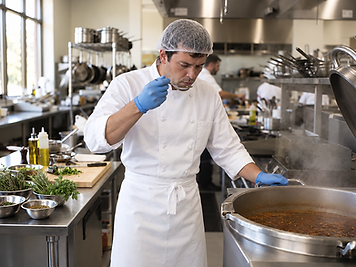
Will Collins
“If it doesn’t taste like the recipe you brought us, it isn’t ready to run.”
Will leads every culinary-first project at Frogmore. With more than 23 years in food and beverage, including six in food manufacturing and co-packing, he pairs a chef's palate with the discipline of food science.
Clean, flavor-forward formulation is his passion, and he leads research and development for Seaside Grown.

 Will Collins · Frogmore Bottling Company
Shelf-Stable vs. Culinary-First
Both have their place. Here’s what changes when ambient shelf stability isn’t required.
Ingredients: Water, soybean oil, vinegar, sugar, salt, modified food starch, xanthan gum, potassium sorbate and sodium benzoate (preservatives), natural flavor, calcium disodium EDTA, caramel color.
Ingredients: Extra virgin olive oil, red wine vinegar, fresh parsley, garlic, lemon juice, sea salt, black pepper.
Illustrative example labels, not specific products.
From Your Recipe to the Shelf
- 1
Your recipe
Share your recipe, your story and what makes the product yours.
- 2
Tasting with Will
Will tastes it with you and learns what has to stay exactly the same.
- 3
Clean formulation
We adapt the recipe for production without adding what it doesn’t need.
- 4
Pilot batch
A small run you approve on taste, texture and specs before scaling.
- 5
Production
Full commercial runs with the same flavor, batch after batch.
Our Specialty:
- Culinary-inspired recipe development
- Clean-label product formulation
- Fresh-flavor sauces, dressings, dips, and marinades
- Custom recipe development and commercialization
- Scaling signature recipes into commercial manufacturing
Born From Seaside Grown
Seaside Grown is our own brand, and it started with the same idea: great food, quality ingredients, and a product people genuinely love. Every culinary-first project draws on what we’ve learned building it, from the first test batch to a product on the shelf.
Go deeper on culinary-first manufacturing
Clean Label Without Compromise: Why Refrigerated Manufacturing Protects Flavor
Shelf-stable products give up something to last at room temperature. This paper explains what that trade-off is, what changes when a product is made to stay cold, and when clean label is and is not the right choice.
Read the paperFrom Restaurant Recipe to Commercial Production: Scaling Without Losing What Works
A step-by-step guide to turning a signature sauce, dressing or dip into a consistent, production-ready product in foodservice bags, and what to expect at each stage.
Read the paperSelling Refrigerated Products Through Foodservice: Cold Chain, Shelf Life and Broadline Distribution
Refrigerated, clean-label products move mostly through foodservice, not retail. This paper covers how the cold chain works, how shelf life shapes planning, and why broadline distributors are the natural path to market.
Read the paperCommon Questions
You bring the culinary vision. We help bring it to market, without sacrificing what makes it exceptional.