Contamination is not a defect rate, it is a total loss
In most manufacturing, a contamination event damages a percentage of output. In bottling, it usually does not work that way. A single compromised valve seat, a biofilm in a fill line, or an unsterilized closure introduces organisms into everything that passes through after it. You do not lose a few bottles — you lose the run, the packaging, the ingredients, the line time, and the delivery date behind it.
Then it gets more expensive. A shelf-stable product that ferments or spoils in distribution becomes a retailer chargeback, a recall exposure, and a conversation with a buyer who will remember it for years. Public safety is the first reason sanitation is non-negotiable. Brand survival is the second.
This is why a plant's sanitation program is not a support function sitting behind production. It is production. Everything else — recipe, format, throughput — is downstream of whether the environment is clean.
The standard sets the floor, not the ceiling
SQF certification and GFSI recognition establish that a documented sanitation program exists, that it is followed, and that an outside auditor verified it. That matters, and it is why serious retailers require it. But certification is a floor. What separates plants is what happens between audits, every single shift.
Clean-In-Place: the automated wash
Clean-In-Place (CIP) is a closed, automated cycle that circulates cleaning solution, sanitizer, and hot water through tanks, pipes, pumps, valves, and fill heads without dismantling the machinery.
The reason CIP exists is not convenience. Manual disassembly and hand-washing introduces two problems: it is inconsistent between operators and shifts, and every teardown is another opportunity to reintroduce contamination from hands, tools, and air. CIP replaces judgment with a validated recipe — a defined caustic wash, rinse, acid wash, rinse and sanitize sequence run at controlled temperature, flow rate, concentration and dwell time.
Those four variables are the whole game. A cycle that runs at the wrong temperature, or moves too slowly to create turbulent flow, or uses under-concentrated chemistry, will look like it ran and will not have cleaned. Which is why CIP cycles are logged, not just performed.
The point of CIP is soil and biofilm removal. It gets the surfaces genuinely clean. Clean is a prerequisite for the next step, because you cannot sterilize a dirty surface — organic residue shields organisms from sanitizers and steam alike.
Sterilize-In-Place: killing what is left
Sterilize-In-Place (SIP) follows CIP and does a different job. Where CIP removes soil, SIP kills the microorganisms that remain on a now-clean surface, using culinary steam or a chemical sterilant held at validated temperature and contact time.
The distinction is worth internalizing, because it is where a lot of brands get misled. "We clean the lines every night" describes CIP. It does not describe SIP. A visibly spotless line can still carry viable spoilage organisms. For products with tight microbial specs — and for any product making an extended shelf-stable claim — the sterilization step is what actually protects the run.
Both steps generate records: cycle time, temperature, chemical concentration, and confirmation of completion. Those records are the evidence.
Controlling the environment, not just the equipment
Sterile equipment filling in dirty air is a solved-then-unsolved problem. Airborne yeast, mold spores, and bacteria settle into open containers and onto the fill zone during the seconds between rinsing and capping — which is precisely the window that matters.
Cleanrooms. High-risk filling areas are enclosed rather than left open to the general plant floor, isolating the critical zone from traffic, forklifts, packaging dust, and the rest of the operation.
Positive air pressure. The enclosed filling area is held at a slightly higher pressure than the surrounding space, so air flows outward through every gap and doorway. Unfiltered air never migrates in. This one piece of physics does an enormous amount of work.
HEPA filtration. The air feeding that zone is continuously filtered to remove dust, bacteria, and airborne particulate. Filters are monitored and changed on schedule, and the environment itself is swabbed and plated — environmental monitoring — so the plant knows its baseline and can see a trend before it becomes an event.
Personnel discipline belongs in this same category: dedicated garments, hairnets and beard covers, footwear control and boot sanitizing at zone entry, hand hygiene stations, and jewelry restrictions. People are the most common vector into a clean zone, and no amount of filtration compensates for casual traffic control.
The container is a contamination source until you treat it
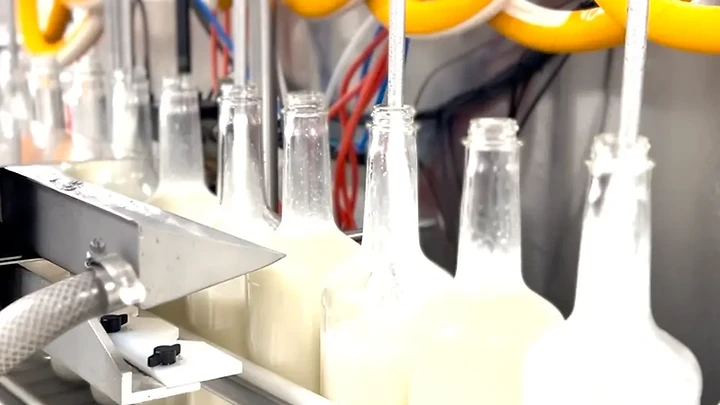
A pristine product filled into an untreated bottle is a compromised product. Empty glass and PET arriving on pallets carry warehouse dust, packaging fibers, static-clung particulate, and occasionally worse. Every container gets treated immediately before filling — not the night before, not upstream in a staging area, but in line, seconds ahead of the fill head.
Ionized air rinsing. A charge neutralizes static so particulate releases from the container wall, then the bottle is inverted and blasted clean. Dry, fast, no water residue — the right answer for products where dilution or moisture is a concern.
Sterile water rinsing. Where a wet rinse is appropriate, the rinse water itself is treated so the rinse cannot become the contamination source.
Chemical sterilization. For higher-risk products, containers are rinsed with a sterilant such as peracetic acid or hydrogen peroxide at validated concentration and contact time, followed by a validated removal step so no residue reaches the product.
The closure is the last chance to fail
This is the step most often overlooked in conversation and least often overlooked by a good plant. Caps and closures arrive in bulk, are handled, and sit in hoppers. A sterile bottle full of sterile product, sealed with a contaminated cap, spoils from the headspace down — and it spoils weeks later, in distribution, where it is most expensive to discover.
Closures are treated before application: UV light exposure as they feed toward the capper, or a chemical bath with a validated dry-off, depending on the closure type and the product. In hot fill production, the thermal step and post-fill inversion add another layer — inverting the sealed bottle brings hot product into contact with the entire cap and neck interior, sterilizing the one surface the fill itself never touched.
Then it gets verified: cap tightness checks confirm application torque, and vacuum seal verification confirms the container actually pulled and held its seal. A bottle that fails either check has no shelf life claim worth making, no matter how clean everything upstream was.
Traceability is part of sanitation
If something does go wrong, the question becomes how narrowly you can define the problem. Ingredient lot recording, batch numbering, and stage-level production records determine whether a contamination event is a contained, documented, three-pallet problem or an undefined exposure across every SKU you shipped that month.
Brands tend to think of lot traceability as paperwork. It is the difference between a bounded corrective action and an unbounded one.
What to ask before you book a run
Ask these, and listen for whether the answers are specific:
- Do you run CIP, SIP, or both — and can I see the cycle parameters and completion logs? "We clean nightly" is not an answer to this question.
- Is the filling zone enclosed, and is it under positive pressure with HEPA-filtered air? Ask to see it during a run, not on a tour of an idle plant.
- How are my containers treated immediately before fill, and how are closures sanitized? If closure sanitation is not part of the answer without prompting, ask why.
- Do you run cap tightness and vacuum seal verification on every batch, or on a sample? Every batch is the answer you want, and it should be documented per batch.
- What does your environmental monitoring program cover, and what do you do with a positive result? A plant with no positives has probably not looked hard.
- What sanitation and QC records come to me with each run, without me asking?
- Walk me through your last contamination event or hold. Any plant running real volume has had one. A plant that claims otherwise is either new or not being straight with you. What you want to hear is how they found it, contained it, and changed the procedure afterward.
The uncomfortable summary
Sanitation is the least visible thing you buy from a co-packer and the most consequential. You cannot taste it, and you cannot see it on a finished pallet. It shows up as an absence — no spoilage complaints, no chargebacks, no recall, no batch you had to dump.
A plant that treats sterility as the top priority will tell you exactly how, with records. A plant that treats it as a compliance obligation will tell you it is certified and change the subject. Both statements sound reassuring. Only one of them is verifiable.